Every product tagged, without watching the video
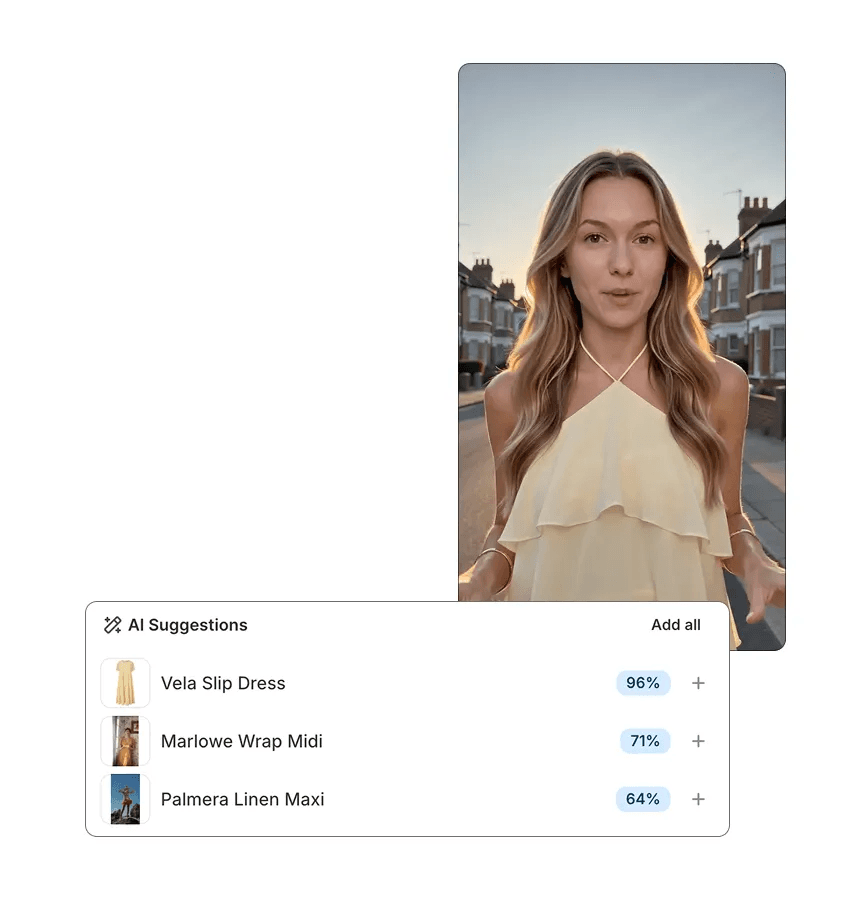
Storista finds your products in every frame and suggests the match. You confirm, the tile goes shoppable.
Nothing to train. Matching runs against your live catalog from the moment you install.
Four things happen. You do one of them
From upload to a shoppable tile — no timeline scrubbing, no product picker, no spreadsheet of SKUs.
Your Shopify catalog stays in sync
Products and images are read as they arrive in your store, not once at install. Add a product or swap a photo and matching picks it up on its own — nothing to rebuild, nothing to re-upload.
The whole video is read, not the cover
Frames are sampled across the full clip, so a product held up for two seconds at 0:14 is found the same as the one in the thumbnail. Multiple products in one video get multiple tags.
Matches come back ranked
Each suggestion carries its runners-up. When two variants look alike on camera you see both rather than having one quietly chosen for you, and swapping is a single click.
You confirm, then it publishes
Nothing goes live off a guess. Tags appear in your review queue, and a video with no confident match ships untagged rather than pointing a shopper at the wrong product.
Tagging on every plan
Matching is the part that depends on your catalog rather than our code, so we cover it two ways.
Free and Starter
Tag it yourself
Our Shopify video product tagging tool makes manual tagging a breeze on both Free and Starter plans. We do believe that everyone should be able to monetize their content from day one, which’s why our core player is ready out of the box.
Growth and Scale
Matched for you on upload
Let AI do the heavy lifting: our Shopify video product tagging tool uses automatic matching to instantly scan footage and link props directly from your Shopify catalog.
The frames that usually break matching
Catalog photography is lit, centred and still. Video is none of those things. These are the cases we tune against.
Small things, big frames
A lip balm held at arm's length occupies a fraction of the shot. Matching runs on the region that matters rather than the whole frame average.
Sachets and soft packs
Pouches crease, fold and catch light in ways a flat packshot never does. We test this category specifically, because it is where naive matching falls apart first.
Several products at once
A routine video with four bottles on a shelf returns four tags at four timestamps, not one guess for the clip.
Held, worn, half covered
Hands over labels, a bottle turned away, a garment on a body rather than a mannequin. Partial views are matched on what is visible.
Motion and phone lighting
UGC is shot handheld in a bathroom. Blur and colour cast shift the image, so matching leans on shape and layout as well as colour.
Catalog in the thousands
Ranking quality is what matters at scale, not just top-one accuracy. More SKUs means more near-neighbours, which is exactly why suggestions come with alternatives.
Tested on real catalogs, not a demo set
Matching claims are only worth what they are measured on. Ours are measured on live merchant products and their own video, re-run whenever the model changes.
3
minutes of manual tagging removed per video
Measured against the same videos tagged by hand in the product picker.
80%
of tags accepted as the top suggestion
Across held-out merchant sets, counting only tags a merchant confirmed without swapping.
10
merchant catalogs in the test set
Different verticals, catalog sizes and photography standards, so one tidy store cannot carry the number.
Every model change is scored against the same held-out sets before it ships, including the categories that historically matched worst. A change that improves the average but loses sachets does not go out.
What we don't claim
Where the line is
Identical variants stay ambiguous
Two colourways that differ by a swatch the camera never shows are not separable from video alone. We return both and let you choose, rather than picking one and being right half the time.
We match your catalog, not the world
If the creator is holding something you don't sell, there is nothing to match to. That video comes back with no tag, which is the correct answer and not a failure.
Your product images set the ceiling
A product with a single dark, cropped, on-model shot matches worse than one with a clean front image. Improving the catalog photo improves the match, and there is nothing we can do from our side about the first one.
Suggestions are not autopilot
Matching never publishes on its own. If nobody reviews the queue, videos stay untagged — deliberately, because a wrong product link costs more than a missing one.
Tagging questions
How accurate is it, really?
Can it tag a product I don't stock?
How large can my catalog be?
How long does the first index take?
What happens when I add new products?
Does it work on creator video I didn't shoot?
Do you train on my catalog or my videos?
Still stuck?
Upload one video and see what it finds
Just upload video files from your daily feeds and watch the automatic matching queue build itself in seconds. You review, you confirm, and then – you publish. Try Storista today to tag products in video, and start generating revenue with zero code required.